Valve Pressure Drop Explained: Is Higher Pressure Drop Better? A Complete Guide for Valve Selection
Valve pressure drop is one of the most important parameters in industrial valve selection and system design.
Many people have a common misunderstanding:
“The higher the upstream pressure, the larger the valve pressure drop.”
However, this is not always correct.
Valve pressure drop is not determined by upstream pressure alone. It mainly depends on factors such as flow rate, fluid properties, valve design, valve opening position, and flow conditions.
Valve pressure drop represents the difference between the pressure before and after the valve:
ΔP = P₁ - P₂
Where:
- P₁ = upstream pressure of the valve;
- P₂ = downstream pressure of the valve.
Simply speaking, valve pressure drop represents the energy loss of the fluid when passing through the valve.
Understanding valve pressure drop is essential for selecting the correct valve type, ensuring system efficiency, and preventing problems such as cavitation, noise, and vibration.
Why Does a Valve Create Pressure Drop?
When fluid flows through a valve, the internal flow passage causes changes including:
- Flow contraction;
- Flow direction changes;
- Expansion;
- Turbulence.
When the fluid passes through throttling areas such as the valve plug and seat, the flow area decreases and the velocity increases, resulting in a reduction in static pressure.
At certain locations inside the valve, the fluid reaches maximum velocity and minimum pressure. This area is called the vena contracta.
After passing through this area, the fluid velocity gradually decreases and pressure partially recovers. However, the pressure cannot return completely to the upstream level because part of the fluid energy has already been lost due to:
- Local resistance;
- Turbulence;
- Flow separation;
- Eddy formation;
- Wall friction.
This energy loss appears in the system as valve pressure drop.
Therefore, valve pressure drop is not simply “pressure consumed by the valve.” It is the result of fluid mechanical energy loss caused by resistance inside the valve.
Valve Pressure Drop Is Not Determined by Upstream Pressure Alone
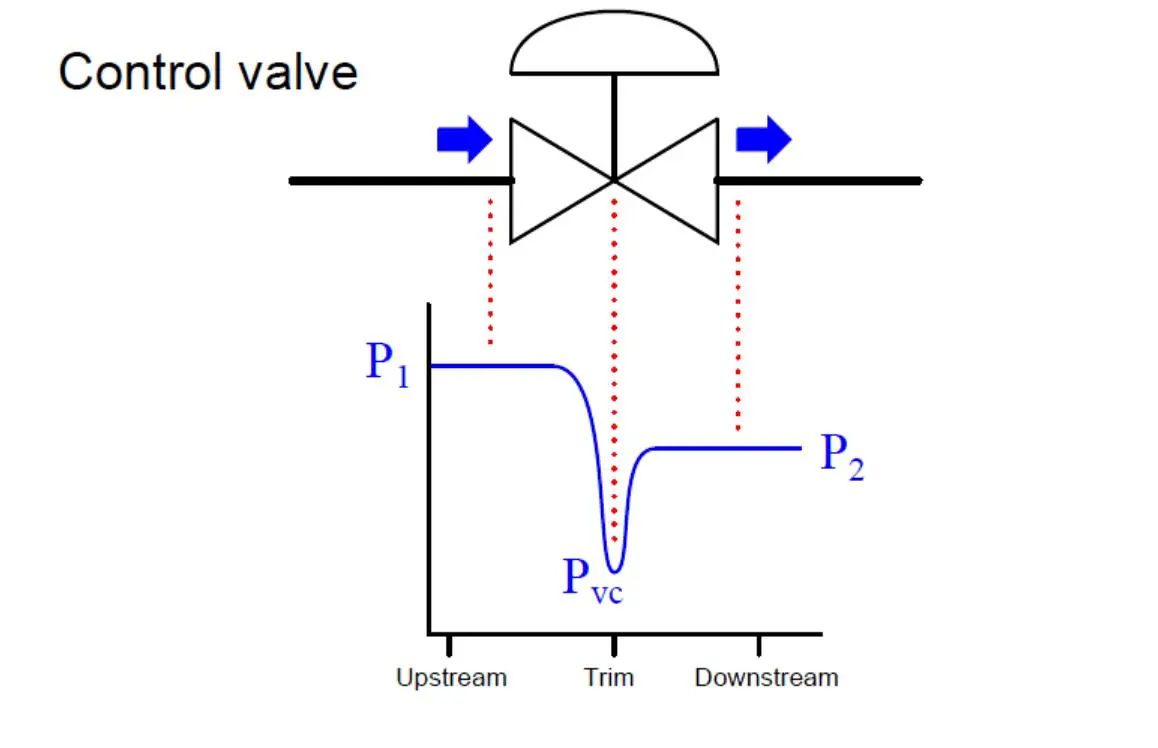
Valve pressure drop cannot be judged only by looking at inlet pressure.
For stable single-phase liquid flow, valve pressure drop can generally be expressed as:
ΔP = K × ρ × v² / 2
Where:
- K = valve resistance coefficient;
- ρ = fluid density;
- v = average flow velocity.
This formula shows that pressure drop mainly depends on:
- Valve structure;
- Fluid density;
- Flow velocity.
For the same valve:
- Same opening position;
- Same fluid;
- Same temperature;
- Same flow rate;
the flow resistance remains almost unchanged, and the valve pressure drop will also remain nearly the same.
Therefore, increasing upstream pressure does not automatically mean increasing valve pressure drop.
Does Higher Upstream Pressure Mean Higher Valve Pressure Drop?
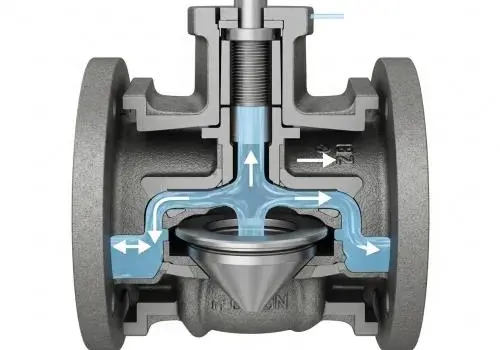
The answer is not necessarily.
Upstream pressure represents the pressure at one specific point, while valve pressure drop represents the difference between two pressure points.
They are different concepts.
For example:
Condition A:
Upstream pressure:
0.6 MPa
Downstream pressure:
0.4 MPa
Pressure drop:
ΔP = 0.2 MPa
Condition B:
Upstream pressure:
1.0 MPa
Downstream pressure:
0.8 MPa
Pressure drop:
ΔP = 0.2 MPa
Although Condition B has higher upstream pressure, the valve pressure drop is the same.
Therefore, judging valve pressure drop only by upstream pressure is incorrect.
Main Factors Affecting Valve Pressure Drop
Valve pressure drop is mainly affected by flow conditions, valve design, and fluid characteristics.
| Factor | Influence on Pressure Drop |
|---|---|
| Flow rate | Higher flow velocity usually increases pressure drop |
| Valve opening | Smaller opening creates stronger throttling and higher pressure drop |
| Valve design | Different valve structures have different resistance coefficients |
| Fluid density | Higher density increases pressure loss |
| Flow condition | Cavitation, flashing, and choked flow change pressure behavior |
Different valve types have different pressure drop characteristics.
For example:
- Ball valves usually have low pressure loss when fully open;
- Gate valves are suitable for low resistance applications;
- Globe valves provide strong throttling capability but generate higher pressure drop;
- Control valves are designed specifically to regulate flow and pressure.
Cavitation and Flashing in Liquid Applications
In liquid systems, high pressure drop may cause special flow problems.
When fluid passes through a valve restriction, the local pressure may decrease below the vapor pressure of the liquid.
At this point, two different phenomena must be considered.
Cavitation
Cavitation occurs when vapor bubbles form at low pressure areas and then collapse after pressure recovery.
Bubble collapse generates strong impact forces, which may cause:
- Valve plug damage;
- Seat erosion;
- Noise and vibration;
- Reduced valve service life.
Flashing
Flashing occurs when downstream pressure remains below the vapor pressure of the liquid.
The vapor bubbles do not collapse but continue downstream as a two-phase flow.
Flashing mainly causes:
- High-speed erosion;
- Damage to downstream piping;
- Internal valve wear.
Therefore, high differential pressure liquid valves require proper cavitation and flashing analysis.
Choked Flow in Gas Applications
For gas systems, increasing differential pressure does not always result in unlimited flow increase.
When the gas velocity reaches the critical condition at a certain point inside the valve, the system enters choked flow.
Under choked flow conditions:
- Further reducing downstream pressure will not significantly increase flow rate;
- Gas velocity has reached the maximum critical value;
- Noise and vibration may increase.
Therefore, gas valve selection under high differential pressure conditions should consider:
- Critical flow conditions;
- Outlet velocity;
- Noise control;
- Vibration prevention.
Effects of High Valve Pressure Drop
High pressure drop means that a large amount of fluid energy is released inside the valve.
If not properly controlled, it may cause:
- Valve plug erosion;
- Seat damage;
- Cavitation damage;
- Flashing erosion;
- Increased gas noise;
- Pipeline vibration;
- Reduced control performance.
Therefore, high pressure differential valves cannot be selected only based on:
- Valve size;
- Pressure rating;
- Connection type.
Other factors must also be considered, including:
- Valve trim design;
- Pressure reduction stages;
- Material wear resistance;
- Anti-cavitation structure;
- Noise reduction design.
For severe high-pressure-drop applications, solutions may include:
- Multi-stage control valve trim;
- Labyrinth valve trim;
- Anti-cavitation valve design.
These designs gradually release pressure energy through multiple stages, preventing excessive energy concentration at a single throttling point.
How to Properly Calculate Valve Pressure Drop?

Valve pressure drop should not be simply estimated based on equivalent pipeline length.
Different valve types have completely different internal structures and resistance characteristics.
For example:
- Ball valves;
- Gate valves;
- Globe valves;
- Butterfly valves;
- Control valves;
all have different pressure drop characteristics.
The same control valve can also have different pressure losses at different opening positions.
Therefore, formal valve selection should be based on:
- Cv value;
- Kv value;
- Flow characteristic curves;
- Manufacturer calculation data.
For control valves especially, pressure drop and valve opening percentage should be calculated according to actual operating conditions.
Conclusion
Valve pressure drop is not a parameter where “higher is always better” or “lower is always better.”
A proper pressure drop design should consider:
- Flow requirements;
- Fluid characteristics;
- Valve type;
- System pressure;
- Process requirements.
Excessive pressure drop may cause:
- Cavitation;
- Noise;
- Vibration;
- Valve damage.
However, insufficient pressure drop may reduce the valve’s control capability.
Therefore, during valve selection, engineers should correctly understand the meaning of pressure drop and evaluate it together with Cv/Kv data and actual operating conditions.
Valve pressure drop represents the energy loss of fluid passing through the valve, not simply the level of upstream pressure.
FAQ
Q1: Is higher valve pressure drop better?
No. Higher valve pressure drop is not always better. Excessive pressure drop may cause cavitation, noise, vibration, and valve damage. The correct pressure drop depends on the process requirements and valve application.
Q2: Does higher upstream pressure mean higher valve pressure drop?
No. Upstream pressure alone does not determine valve pressure drop. Pressure drop mainly depends on flow rate, valve structure, fluid properties, and operating conditions.
Q3: Which valve has lower pressure drop?
Generally, fully open ball valves and gate valves have lower pressure loss because of their straight flow paths. Globe valves and control valves usually generate higher pressure drops because they are designed for throttling and flow regulation.

Get professional pre-sales technical consultation and valve selection services, customized solution services.

About CEPAI
Popular Blogs