Understanding Valve Cores: The Key to Truly Understanding Valves — Types, Working Principles, and Selection Guide
In industrial valve selection, many engineers and purchasers focus mainly on valve body materials, pressure ratings, flange standards, and sealing materials. However, the most important internal component that directly controls fluid flow is often overlooked — the valve core (valve trim).
The valve body determines the pressure resistance and structural strength of a valve, while the valve core determines the valve’s shut-off performance, flow regulation capability, reliability, and service life.
Many common valve problems, including internal leakage, unstable flow control, operating difficulties, excessive vibration, and premature wear, are closely related to improper valve core selection or unsuitable materials.
Even valves with the same valve body material can have completely different performance depending on the internal valve core design.
Understanding different valve core types, operating principles, and selection methods is essential for reliable industrial valve applications.
What Is a Valve Core?
A valve core, also known as a closing element or part of the valve trim, is the internal moving component that directly controls the opening, closing, and regulation of the process medium.
The valve core works together with the valve seat to create the sealing and throttling system. Depending on the valve design, the core may rotate, move vertically, or adjust its position to control the flow passage.
Simply speaking:
The valve body provides the strength of the valve, while the valve core determines its function.
The main functions of a valve core include:
- Controlling the opening and closing of pipelines;
- Adjusting flow rate by changing the flow area;
- Reducing pressure through throttling effects;
- Withstanding erosion, corrosion, and mechanical wear from the process medium.
Common Valve Core Types and Their Applications
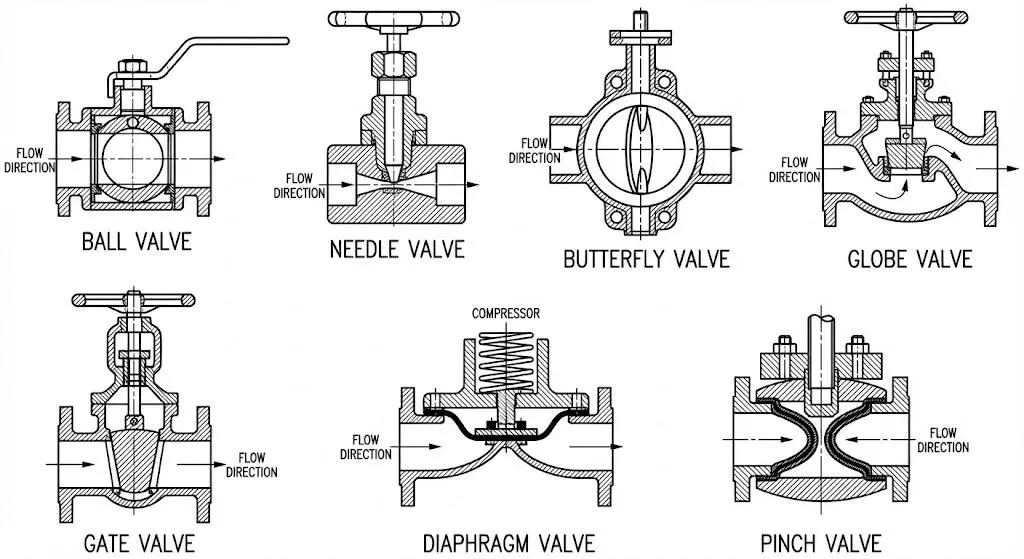
Different valve structures are essentially based on different valve core designs. Selecting the correct valve core is one of the most important steps in industrial valve engineering.
Ball Valve Core
Ball valve cores are among the most widely used valve core designs in industrial applications. They achieve flow control through a 90-degree rotational movement.
The two main types are:
- O-type ball core;
- V-type ball core.
O-Type Ball Core
Working Principle
The O-type ball core has a circular bore through the center of the ball. When the bore is aligned with the pipeline, the valve provides a straight-through flow path with minimal pressure loss. When the ball rotates 90 degrees, the opening is completely closed.
Features
- Very low flow resistance;
- Fast opening and closing operation;
- Excellent sealing performance;
- Suitable for frequent operation.
However, because the flow passage is fixed, the O-type ball core has limited regulating capability and is mainly designed for shut-off applications.
Applications
O-type ball valves are widely used in oil and gas pipelines, chemical processing systems, water treatment facilities, and general industrial applications where reliable isolation is required.
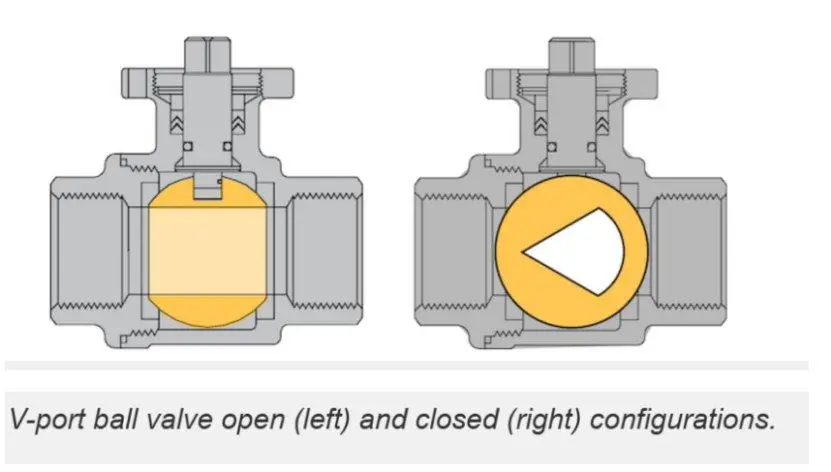
V-Type Ball Core
Working Principle
The V-type ball core has a V-shaped opening. During rotation, the changing opening area between the ball and valve seat provides accurate flow control.
Features
- Excellent regulating performance;
- Equal percentage flow characteristics;
- Good shearing capability for certain media containing particles or fibers.
Applications
V-type ball valves are commonly used in chemical slurry systems, wastewater treatment, and industrial process control applications where accurate flow adjustment is required.
Butterfly Valve Disc
The butterfly valve disc is the main operating component of a butterfly valve. It uses a disc-shaped structure that rotates around the valve shaft to control the flow passage.
Features
- Compact structure and lightweight design;
- Small installation space requirement;
- Cost-effective solution for large diameter pipelines.
Compared with ball valves, butterfly valves generally have higher flow resistance and more limitations under high pressure or high temperature conditions.
Applications
Butterfly valve discs are widely used in water supply systems, HVAC systems, ventilation pipelines, and low-pressure industrial applications.
Gate Valve Wedge
The gate valve wedge is the core component of a gate valve. It moves vertically to achieve full opening or complete shut-off of the pipeline.
Common designs include:
Wedge gate;
Parallel gate.
Working Principle
When the wedge moves upward, the pipeline becomes fully open. When it moves downward and contacts the valve seats, the valve achieves shut-off.
Features
- Extremely low flow resistance when fully open;
- Suitable for large pipeline systems;
- Good sealing performance.
However, gate valves are not designed for flow regulation. Operating a gate valve in a partially open position may cause high-speed fluid erosion and damage the sealing surfaces.
Applications
Gate valve wedges are commonly used in oil and gas transmission pipelines, industrial main pipelines, and large-scale water treatment systems.
Globe Valve Disc
The globe valve disc controls flow by moving vertically against the valve seat and changing the flow passage area.
Features
- Excellent throttling capability;
- Good flow regulation performance;
- Reliable sealing characteristics.
The disadvantage is that the internal flow path creates higher pressure loss compared with ball valves and gate valves.
Applications
Globe valve discs are widely used in steam systems, high-pressure throttling applications, and industrial process control pipelines where accurate flow adjustment is required.
Needle Valve Core
The needle valve core is designed with a long and tapered structure, allowing precise control of very small flow rates through small changes in valve opening.
Compared with other valve core designs, the needle valve core provides the highest level of precision for micro flow adjustment.
Features
- Excellent flow adjustment accuracy;
- Smooth control of small flow rates;
- Reduces sudden pressure changes during adjustment.
However, due to its small flow passage, the needle valve core has limited flow capacity and is not suitable for large pipeline systems.
Applications
Needle valve cores are mainly used in instrumentation systems, pressure measurement lines, laboratory equipment, hydraulic systems, and applications requiring precise flow control.
Plunger Valve Core
The plunger valve core is designed for applications requiring stable performance under high pressure differential conditions.
Its rigid structure provides strong resistance against erosion, cavitation, and pressure fluctuations, making it suitable for demanding industrial processes.
Features
- Good resistance to erosion and cavitation;
- Stable flow regulation performance;
- Suitable for high-pressure differential applications.
Because of its precision structure, plunger valve cores usually require relatively clean media. Solid particles may cause sticking or affect operation reliability.
Applications
Plunger valve cores are commonly used in chemical plants, power generation systems, water treatment facilities, and industrial process control applications.
Check Valve Disc
The check valve disc is an automatic valve core designed to prevent reverse flow in pipelines.
Unlike other valve cores, it does not require external operation. It opens when the forward pressure of the medium is sufficient and closes automatically when reverse flow occurs.
Common designs include:
Swing check valve disc;
Lift check valve disc.
Features
- Automatic operation without manual control;
- Protects pumps, compressors, and pipeline equipment;
- Prevents reverse flow damage.
Applications
Check valve discs are widely used in pump outlet pipelines, steam systems, oil and gas facilities, and industrial systems where backflow prevention is required.
Safety Valve Disc
The safety valve disc is a critical safety component used for pressure protection.
It works based on the balance between system pressure and spring force. When the pressure exceeds the preset value, the disc automatically opens to release excess pressure. After the pressure returns to a safe level, the valve closes again.
Features
- Automatic pressure relief;
- Protects equipment from overpressure damage;
- Provides the final safety protection for pressure systems.
Applications
Safety valve discs are mainly used in pressure vessels, boilers, compressors, and high-pressure equipment to prevent dangerous overpressure conditions.
Valve Core Material Selection Guide
Since the valve core directly contacts the process medium, material selection has a significant influence on valve performance, reliability, and service life.
Different operating conditions require different valve core materials.
| Valve Core Material | Characteristics | Typical Applications |
|---|---|---|
| WCB Carbon Steel | High strength, economical, suitable for general applications | Water, steam, ordinary oil products |
| 304 Stainless Steel | Good corrosion resistance and oxidation resistance | General corrosive media |
| 316L Stainless Steel | Excellent chloride corrosion resistance and low carbon content | Seawater, chemical processing |
| Hardfacing Alloy (Stellite) | Excellent wear resistance and erosion resistance | High pressure differential and particle-containing media |
| Monel / Hastelloy Alloy | Superior resistance to strong corrosion | Special chemical applications |
For applications involving high pressure differential, abrasive particles, or high velocity flow, standard stainless steel valve cores may not provide sufficient service life.
In these conditions, hardfacing alloys, special coatings, or corrosion-resistant alloys should be considered to improve wear resistance and reliability.
Common Valve Core Failures and Causes
Valve Leakage
Valve leakage is one of the most common problems related to valve cores.
- Typical causes include:
- Damaged sealing surfaces;
- Foreign particles trapped between valve core and seat;
- Corrosion or deformation;
- Incorrect material selection.
Proper valve core material and sealing design are essential for maintaining reliable shut-off performance.
Unstable Flow Regulation
When a valve cannot maintain stable flow control, possible reasons include:
- Incorrect valve core type selection;
- Excessive wear of the regulating surface;
- Mechanical sticking;
- Improper operating conditions.
For precise flow control applications, selecting a dedicated regulating valve core is more important than simply selecting a valve with a suitable pressure rating.
Difficult Opening or Closing
Valve operation problems are usually caused by:
- Corrosion of internal components;
- Medium crystallization or deposits;
- Foreign particles inside the valve;
- Thermal deformation under high temperature conditions.
Regular inspection and proper material selection can significantly reduce these failures.
Noise and Vibration
Excessive noise and vibration often occur in high pressure differential applications.
Common causes include:
- Cavitation;
- Flashing;
- Excessive throttling;
- Insufficient erosion resistance of the valve core.
For severe service applications, special valve core designs should be considered.
Key Principles for Valve Core Selection
Select Shut-Off Valve Cores for Isolation Applications
For applications requiring reliable opening and closing, ball valve cores and gate valve wedges are commonly preferred because of their excellent sealing capability and low leakage risk.
Select Regulating Valve Cores for Flow Control
When precise flow adjustment is required, V-type ball cores, needle valve cores, and plunger valve cores provide better control performance.
The correct selection depends on flow rate, pressure difference, medium characteristics, and required control accuracy.
Consider Wear Resistance for Particle-Containing Media
For slurry, mining, wastewater, and abrasive applications, ordinary valve materials may wear quickly.
Hardfacing alloys, wear-resistant coatings, or special alloy materials can significantly improve service life.
Select Materials According to Corrosion Conditions
Material selection should always consider the actual operating environment.
Typical selection principles:
Carbon steel for normal non-corrosive applications;
304 stainless steel for general corrosive environments;
316L stainless steel for chloride-containing environments;
Special alloys for highly corrosive chemical media.
Avoid Using Gate Valves for Throttling
Gate valves are designed for fully open or fully closed operation.
Long-term operation at partial opening may cause high-speed erosion of the wedge and sealing surfaces, resulting in leakage, vibration, and premature failure.
Conclusion: The Valve Core Determines Valve Performance
The valve body determines the pressure capability of a valve, but the valve core determines its control performance, sealing reliability, and service life.
A successful industrial valve selection process requires more than choosing the correct pressure class and body material. Engineers must also consider:
- Medium characteristics;
- Operating temperature;
- Working pressure;
- Flow requirements;
- Corrosion and erosion conditions.
By understanding different valve core structures and selecting the appropriate materials, industrial valves can achieve safer operation, longer service life, and better overall performance.
FAQ
What is the most important part of a valve?
The valve core is one of the most important internal components because it directly controls flow, sealing, and regulation. While the valve body provides structural strength, the valve core determines the valve’s actual operating performance.
What is the difference between an O-type and V-type ball valve core?
An O-type ball core is mainly designed for full opening and closing applications. It provides low flow resistance and excellent sealing performance.
A V-type ball core has a V-shaped opening that provides better flow regulation capability and is suitable for applications requiring precise control.
Which valve core is suitable for flow regulation?
For flow regulation applications, V-type ball cores, needle valve cores, globe valve discs, and plunger valve cores are commonly selected depending on the required control accuracy and operating conditions.

Get professional pre-sales technical consultation and valve selection services, customized solution services.
About CEPAI
Popular Blogs