How to Select a Solenoid Valve? Working Principles, Selection Parameters, and Key Considerations
A solenoid valve is a common automatic control component used in industrial systems. It controls the flow of gases or liquids by energizing or de-energizing an electromagnetic coil. Solenoid valves are widely used in compressed air systems, water treatment, petrochemical plants, natural gas pipelines, steam systems, fire protection equipment, pharmaceutical production, food processing, and industrial automation. Although the structure of a solenoid valve is relatively simple, proper selection requires careful consideration of the medium, pressure, temperature, valve size, voltage, explosion-proof rating, and operating mode. An incorrect selection may result in failure to open, incomplete closing, coil burnout, seal leakage, or even damage to the entire control system. This article explains how to select a solenoid valve by introducing its working principles, structural types, selection parameters, and installation considerations.
What Is a Solenoid Valve?
A solenoid valve is an automatic valve that uses electromagnetic force to control the opening and closing of a fluid passage. When the coil is energized, electromagnetic force moves the plunger or valve element, causing the valve to open or close. When the coil is de-energized, the valve returns to its original position under spring force or fluid pressure. Most solenoid valves are designed for two-position control, meaning that they are either fully open or fully closed. Unlike control valves, standard solenoid valves are generally not used for continuous flow regulation. Based on their working principles, solenoid valves can generally be divided into three main types:
- Direct-acting solenoid valves
- Semi-direct-acting solenoid valves
- Pilot-operated solenoid valves
Each type has different requirements for pressure differential, valve size, and operating pressure.
Three Main Working Principles of Solenoid Valves
Direct-Acting Solenoid Valve
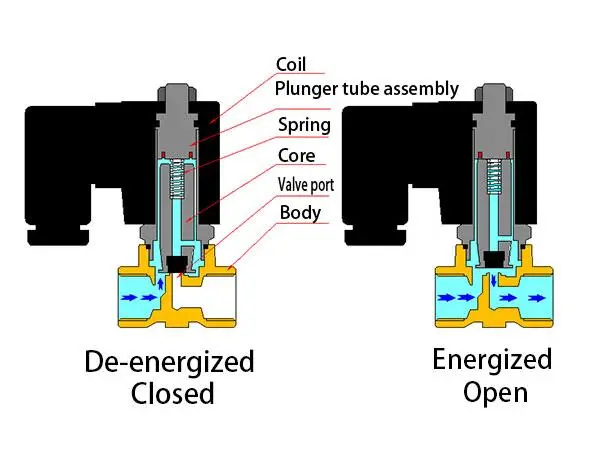
When a direct-acting solenoid valve is energized, the electromagnetic coil generates a magnetic force that directly lifts the plunger or sealing element away from the valve seat, allowing the medium to flow through the valve.
When the coil is de-energized, the electromagnetic force disappears, and the spring pushes the sealing element back onto the valve seat, closing the valve.
A direct-acting solenoid valve does not rely on a pressure difference between the inlet and outlet. Therefore, it can operate under vacuum, negative pressure, low-pressure, or zero-pressure-differential conditions.
The main advantages of direct-acting solenoid valves are reliable operation, fast response, and no minimum pressure differential requirement.
However, because the electromagnetic force must directly overcome the fluid pressure, this structure is normally used for smaller valve sizes, typically DN25 or below.
Direct-acting solenoid valves are suitable for:
- Zero-pressure-differential systems
- Low-pressure pipelines
- Vacuum or negative-pressure applications
- Small-diameter pipelines
- High-frequency operation
- Applications requiring fast response
Semi-Direct-Acting Solenoid Valve
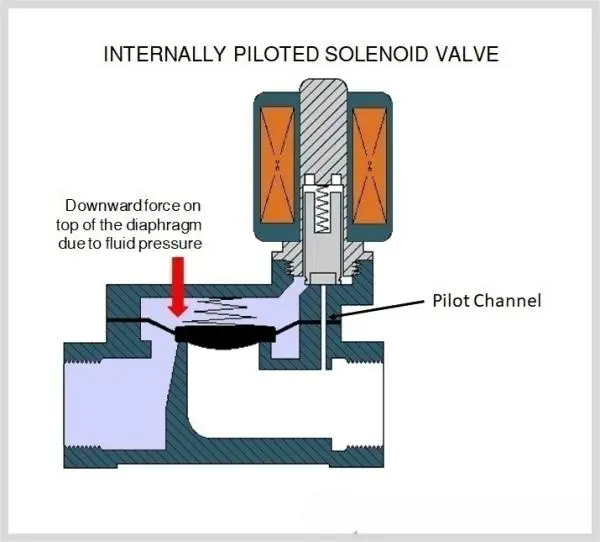
A semi-direct-acting solenoid valve, also known as a combined direct-acting and pilot-operated solenoid valve, combines the operating principles of direct-acting and pilot-operated designs. When there is no pressure differential between the inlet and outlet, the electromagnetic force directly lifts the pilot valve and the main valve element, opening the valve. When a pressure differential exists, energizing the coil first opens the pilot passage. This creates a pressure difference across the main valve element, allowing the fluid pressure to lift the main valve. When the coil is de-energized, the pilot passage closes, and the main valve returns to the closed position under spring force and medium pressure. This type of solenoid valve can operate under zero-pressure-differential conditions while also handling higher pressure and larger valve sizes than a standard direct-acting valve. However, it generally requires more electrical power than a pilot-operated valve. Some models also have installation-direction requirements and should be installed horizontally with the coil positioned vertically upward.
Pilot-Operated Solenoid Valve
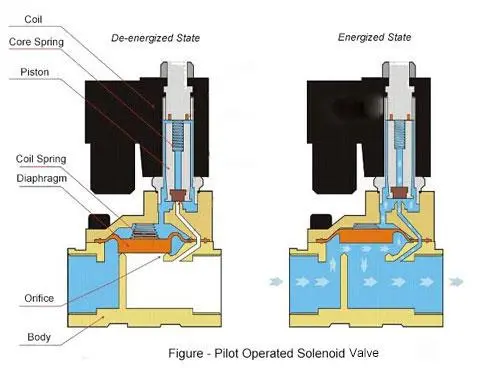
A pilot-operated solenoid valve uses the pressure of the medium itself to operate the main valve. When the coil is energized, the electromagnetic force opens the pilot orifice, causing the pressure in the upper chamber to decrease. The higher inlet pressure below the main valve element then pushes it upward, allowing the valve to open. When the coil is de-energized, the pilot orifice closes. Inlet pressure enters the upper chamber through a bypass passage, increasing the pressure above the main valve element and forcing it downward to close the valve. Pilot-operated solenoid valves are suitable for larger sizes and higher-pressure applications. Their coils generally consume less power than direct-acting designs. However, pilot-operated valves require a minimum pressure differential to operate correctly. If the actual pressure differential is lower than the required minimum value, the valve may fail to open or close properly. Therefore, a standard pilot-operated solenoid valve should not be selected for zero-pressure-differential, extremely low-pressure, or unstable-pressure applications.
Common Solenoid Valve Structural Types
Based on the design of the main valve element, sealing component, and actuation method, solenoid valves can also be classified into the following structures:
- Direct-acting diaphragm type
- Semi-direct-acting diaphragm type
- Pilot-operated diaphragm type
- Direct-acting piston type
- Semi-direct-acting piston type
- Pilot-operated piston type
Diaphragm-type solenoid valves are commonly used for water, air, and other low-viscosity media. They generally provide good sealing performance.
Piston-type solenoid valves normally have better pressure resistance and temperature resistance. They are often used for steam, hot water, high-pressure gas, and industrial oil applications.
The correct structure should be selected according to the medium, operating temperature, pressure range, operating frequency, and sealing requirements.
What Parameters Are Required for Solenoid Valve Selection?
A solenoid valve should not be selected based only on the pipeline size.
A complete selection normally requires confirmation of six groups of parameters:
- Pipeline parameters
- Medium parameters
- Pressure parameters
- Electrical parameters
- Operating mode
- Environmental and special requirements
Safety, reliability, and application suitability should always be considered before cost.
Selecting a Solenoid Valve According to Pipeline Parameters
Nominal Size
The nominal size of a solenoid valve is normally expressed as DN.
It should be selected according to the internal pipeline diameter, required flow rate, and allowable pressure drop.
The solenoid valve size does not always have to be exactly the same as the pipeline size. In some systems with a relatively low flow rate, a smaller valve may be selected based on the required flow coefficient.
However, reducing the valve size only to lower the purchase cost may cause:
- Insufficient flow
- Excessive pressure drop
- High fluid velocity
- Increased noise
- Water hammer
- Shortened valve service life
The valve size should therefore be determined according to the actual flow requirements and pressure-loss conditions.
Connection Type
Common solenoid valve connection types include:
- Female threaded connection
- Male threaded connection
- Flanged connection
- Clamp connection
- Welded connection
Threaded connections are commonly used for solenoid valves DN50 and below.
For sizes above DN50, higher-pressure pipelines, or important industrial systems, flanged connections are generally preferred.
Food, beverage, and pharmaceutical applications may require sanitary clamp or sanitary welded connections.
Selecting a Solenoid Valve According to the Medium
Medium Type
The first step is to identify the fluid flowing through the pipeline.
Common media include:
- Compressed air
- Water
- Steam
- Natural gas
- Fuel gas
- Hydraulic oil
- Corrosive liquids
- Food-grade media
- Pharmaceutical media
- Fluids containing particles or impurities
Different media require different valve body materials, sealing materials, and internal structures.
For example, brass or stainless steel valve bodies may be used for ordinary water and compressed air.
Corrosive media normally require stainless steel, engineering plastic, or special alloy materials.
Food and pharmaceutical applications require food-grade stainless steel and hygienic sealing materials.
Medium State
It is important to confirm whether the medium is a gas, liquid, or gas-liquid mixture.
This directly affects the valve structure, flow calculation, and pressure-loss analysis.
For solenoid valves above DN25, the medium state should always be clearly specified when requesting a quotation or technical selection.
Gas is compressible, while liquid is nearly incompressible. Therefore, their flow characteristics and pressure differential behavior are different.
Medium Temperature
The operating temperature of the medium must remain within the allowable temperature range of the solenoid valve.
Ordinary sealing materials may be suitable for ambient-temperature water, air, and oil.
High-temperature steam or thermal oil applications require high-temperature-resistant coil insulation, sealing materials, and internal components.
Piston-type solenoid valves are generally more suitable for high-temperature media.
For high-temperature service, the design should also prevent excessive heat from transferring from the valve body to the coil, as this may cause insulation aging or coil failure.
Medium Viscosity
Standard solenoid valves are generally designed for low-viscosity fluids.
Some products specify a maximum medium viscosity of approximately 20 cSt, while certain industrial models may allow values of up to 50 cSt.
The actual allowable viscosity depends on the manufacturer and valve model.
For high-viscosity media, a special high-viscosity solenoid valve should be selected.
Otherwise, the valve may experience slow movement, incomplete reset, or internal leakage.
Medium Cleanliness
The internal flow passages and pilot orifices inside a solenoid valve are usually relatively small.
If the medium contains rust, welding slag, particles, or other impurities, a filter should be installed upstream of the solenoid valve.
Pilot-operated solenoid valves generally require cleaner media than direct-acting valves.
A blocked pilot orifice may prevent the main valve from opening or closing.
Selecting a Solenoid Valve According to Pressure Parameters
Nominal Pressure
The nominal pressure rating of the solenoid valve should match the pipeline design pressure.
The maximum allowable operating pressure of the valve must be higher than the maximum pressure that may occur in the system.
Selection should not be based only on the normal operating pressure.
If the system is subject to pressure fluctuations, pump start-up impact, water hammer, or abnormal pressure surges, an appropriate safety margin should be included.
Operating Pressure
Operating pressure refers to the actual inlet pressure applied to the solenoid valve during operation.
Both the maximum and minimum operating pressures should be confirmed.
This is especially important for pilot-operated solenoid valves because insufficient inlet pressure may prevent the required operating pressure differential from being established.
Operating Pressure Differential
The operating pressure differential is the difference between the inlet pressure and the outlet pressure. If the minimum operating pressure differential is below 0.04 MPa, a direct-acting or semi-direct-acting solenoid valve is normally recommended. If the minimum pressure differential remains above 0.04 MPa, a pilot-operated valve may also be considered, depending on the valve size and pressure range. However, 0.04 MPa is only a general reference value for some standard products. The actual minimum operating pressure differential must be confirmed according to the manufacturer’s technical data. If reverse pressure may occur in the pipeline, it is also necessary to confirm whether the solenoid valve supports bidirectional flow. Most standard solenoid valves have a defined flow direction. If reverse flow is possible, a check valve should be installed, or a solenoid valve with an integrated non-return function should be selected.
How to Select the Electrical Parameters of a Solenoid Valve
Supply Voltage
Common solenoid valve coil voltages include:
- DC24V
- AC24V
- AC110V
- AC220V
- DC12V
DC24V is widely used in PLC, DCS, and industrial automation systems. AC220V is commonly used in general equipment and utility systems. The selected coil voltage must match the actual control power supply. Different voltages cannot be used interchangeably. The allowable voltage fluctuation range should also be confirmed according to the manufacturer’s technical data.
Coil Power
The power supply output must be sufficient for both coil start-up and continuous operation. For AC solenoid valves, the apparent power during start-up is usually higher than the holding power during normal operation. Therefore, the starting VA value should also be considered when selecting the power supply.
Electrical Connection
Common electrical connection types include:
- Flying lead
- DIN connector
- Terminal box
- Explosion-proof terminal enclosure
DIN connectors are commonly used in ordinary indoor industrial environments.
For oil and gas, petrochemical, chemical, and other hazardous areas, explosion-proof coils and certified explosion-proof electrical connections are required.
How to Select Normally Closed or Normally Open Solenoid Valves
Solenoid valves can be classified as normally closed or normally open according to their de-energized position.
Normally Closed Solenoid Valve
A normally closed solenoid valve remains closed when the coil is de-energized and opens when the coil is energized. If the system remains closed most of the time and opens only for short periods, a normally closed valve is generally preferred. Normally closed solenoid valves are widely used because they automatically stop the medium when power is lost. They are suitable for applications requiring a fail-close function.
Normally Open Solenoid Valve
A normally open solenoid valve remains open when the coil is de-energized and closes when the coil is energized. If the valve needs to remain open for long periods and only closes occasionally, a normally open design may reduce continuous coil energization and energy consumption. However, in gas shutoff, furnace protection, emergency shutdown, and other safety interlock systems, the valve type must be selected according to the safe condition required after power failure. If the medium must be isolated when power is lost, a fail-close normally closed solenoid valve should be selected.
Selecting a Solenoid Valve According to Operating Frequency
Operating frequency affects the plunger structure, coil temperature, sealing wear, and valve service life.
- For short operating cycles and high-frequency switching, a fast-response direct-acting solenoid valve is generally preferred.
- For large valve sizes and high-frequency operation, a special high-speed solenoid valve should be selected instead of a standard general-purpose model.
- For continuous energization, the coil should be rated for 100% duty cycle.
The ambient temperature and coil heat dissipation conditions should also be considered.
Selecting a Solenoid Valve According to Environmental Conditions
Protection Rating
Standard solenoid valve coils may not always provide sufficient protection against dust or water.
- For outdoor, dusty, or humid environments, a protection rating of IP54 or above is generally recommended.
- For water-spray, washdown, or continuously wet environments, a higher protection rating should be selected.
- For fountains, pools, or submerged equipment, a dedicated submersible solenoid valve is required, normally with an IP68 protection rating.
Explosion-Proof Requirements
In oil, gas, petrochemical, chemical, fuel gas, or other environments containing potentially explosive gases or dust, the solenoid valve must have the appropriate explosion-proof certification and protection level.
The following parameters should normally be confirmed:
- Hazardous area classification
- Gas or dust group
- Temperature class
- Explosion-protection method
- Required certification standard
It is not sufficient to specify only “explosion-proof solenoid valve.”The exact explosion-proof classification and certification requirements should be clearly stated.
Corrosive Environment
If the installation environment contains salt spray, acid gas, alkaline gas, or other corrosive substances, stainless steel valve bodies, corrosion-resistant coatings, and corrosion-resistant coil housings should be considered. For highly corrosive fluids, plastic valve bodies, PTFE seals, or special corrosion-resistant alloys may be required.
Ambient Temperature
- High ambient temperatures may reduce coil heat dissipation and shorten insulation life.
- Low ambient temperatures may cause seal hardening, fluid freezing, or plunger sticking.
Therefore, both the medium temperature and the minimum and maximum ambient temperatures should be confirmed during selection.
How to Select Special Solenoid Valve Functions
Solenoid valves can also be equipped with additional functions according to system operation and maintenance requirements.
Manual Override
If manual operation is required during commissioning, maintenance, or power failure, a solenoid valve with a manual override can be selected.
Non-Return Function
If reverse flow may occur in the pipeline, a solenoid valve with an integrated check function may be used, or a separate check valve may be installed.
Water Hammer Control
If fast valve closure may cause water hammer in a liquid pipeline, a slow-closing solenoid valve or a model with adjustable opening and closing time should be selected. Water hammer may also be reduced by using accumulators, water hammer arrestors, slow-closing check valves, or modified control logic.
Position Feedback
Some automation systems require confirmation that the solenoid valve has completed its movement. In such cases, a solenoid valve assembly with position feedback, a limit switch, or an electrical status signal may be selected.
Solenoid Valve Selection Parameter Table
When requesting a quotation or technical selection from a solenoid valve manufacturer, the following information should be provided:
| Selection Item | Required Information |
|---|---|
| Medium | Water, air, steam, natural gas, oil, or corrosive medium |
| Medium state | Gas, liquid, or gas-liquid mixture |
| Nominal size | DN size or pipeline size |
| Connection type | Threaded, flanged, clamp, or welded |
| Operating pressure | Normal and maximum operating pressure |
| Pressure differential | Minimum and maximum differential pressure |
| Medium temperature | Minimum and maximum operating temperature |
| Ambient temperature | Installation temperature range |
| Valve body material | Brass, stainless steel, plastic, or special alloy |
| Seal material | NBR, EPDM, FKM, PTFE, or other material |
| Supply voltage | DC24V, AC220V, or other voltage |
| Operating mode | Normally closed or normally open |
| Protection rating | IP54, IP65, IP67, or IP68 |
| Explosion-proof requirement | Protection class, gas group, and temperature class |
| Special functions | Manual override, check function, feedback, or slow opening and closing |
If the above parameters are incomplete, the manufacturer may only be able to provide a preliminary selection based on general operating conditions.
The suitability of the valve for the actual application cannot be fully guaranteed without complete technical information.
Common Solenoid Valve Selection Mistakes
Selecting Only by Pipeline Size
Solenoid valves with the same nominal size may have completely different pressure ranges, flow capacities, and operating principles. The DN size alone is not sufficient for accurate selection.
Ignoring the Minimum Operating Pressure Differential
This is one of the most common mistakes when selecting a pilot-operated solenoid valve. If the actual pressure differential is lower than the required minimum value, the main valve may fail to open even if the coil is energized correctly.
Failing to Confirm the Medium Temperature
Ordinary seals and standard coils cannot be used directly for high-temperature steam or thermal oil. Excessive temperature may cause seal aging, coil burnout, or valve leakage.
Incomplete Explosion-Proof Selection
A standard waterproof coil cannot replace an explosion-proof coil in a hazardous area. An IP protection rating and an explosion-proof rating are two different concepts. The IP rating indicates resistance to dust and water, while the explosion-proof rating indicates whether the equipment can be safely used in an explosive atmosphere.
Ignoring the Flow Direction
Most solenoid valves have a specified inlet and outlet direction. Incorrect installation may cause leakage, incomplete closing, failure to operate, or internal component damage.
Using a Standard Solenoid Valve for Dirty Media
Particles may block the pilot passage or cause the plunger to stick. If the medium contains impurities, a filter should be installed or a valve designed for contaminated media should be selected.
Solenoid Valve Installation Considerations
Before installation, the nameplate information should be checked carefully to confirm that the valve size, pressure rating, temperature range, voltage, and operating mode meet the design requirements.
The following installation points should also be considered:
- Install the valve according to the flow-direction arrow on the valve body.
- Clean welding slag, rust, and other debris from the pipeline before installation.
- Install a filter upstream if the medium is not clean.
- Install the coil vertically upward unless otherwise approved by the manufacturer.
- Avoid transferring pipeline loads directly to the valve body.
- Consider water hammer and pressure surges in liquid systems.
- Install a bypass line if continuous operation and easy maintenance are required.
- Confirm that the supply voltage matches the coil nameplate before wiring.
Install and seal explosion-proof electrical connections according to applicable hazardous-area standards.
Some solenoid valves may be installed in any direction, but this must be confirmed with the manufacturer before ordering.
It should not be assumed that every solenoid valve can be installed vertically, horizontally, or upside down.
Four Main Principles of Solenoid Valve Selection
Solenoid valve selection should follow four main principles.
The first principle is safety.
The pressure rating, temperature range, material, and explosion-proof classification must meet the safety requirements of the operating environment.
The second principle is reliability.
The solenoid valve must operate consistently under the actual pressure differential, switching frequency, and duty cycle.
The third principle is suitability.
The valve structure, medium compatibility, sealing material, connection type, and control voltage must match the actual operating conditions.
The fourth principle is economy.
Only after safety, reliability, and suitability have been confirmed should the purchase price, service life, maintenance cost, and power consumption be compared.
A valve with an insufficient pressure rating, temperature range, or material grade should never be selected only to reduce the initial purchase cost.
Conclusion
Solenoid valve selection involves much more than confirming the valve size and coil voltage. The medium, operating pressure, pressure differential, temperature, flow rate, valve body material, sealing material, operating mode, protection rating, and explosion-proof requirements must all be evaluated. For zero-pressure-differential, small-size, or high-frequency applications, a direct-acting solenoid valve may be the preferred option. For larger valve sizes and systems with a stable pressure differential, a pilot-operated solenoid valve may be more suitable. When zero-pressure-differential operation and higher pressure capacity are both required, a semi-direct-acting design may be considered. Before placing an order, complete operating parameters should be submitted to the manufacturer. The allowable pressure range, minimum operating pressure differential, medium compatibility, and installation requirements should also be confirmed. Correct solenoid valve selection improves operating reliability, reduces leakage and failure risk, and helps prevent unplanned system shutdowns.
Frequently Asked Questions
Can a solenoid valve operate without a pressure differential?
Some solenoid valves can operate without a pressure differential. Direct-acting and certain semi-direct-acting solenoid valves can operate under zero-pressure-differential or low-pressure-differential conditions. A standard pilot-operated solenoid valve normally requires a minimum pressure differential. If the pressure differential is insufficient, the valve may fail to open.
Should I select a normally open or normally closed solenoid valve?
If the valve remains closed most of the time and opens only occasionally, a normally closed valve is generally suitable. If the valve remains open for long periods and closes only occasionally, a normally open valve may be considered. For safety interlock applications, the selection should be based on the required safe condition after power failure.
Which is better, a DC24V or AC220V solenoid valve?
Neither voltage is universally better. The correct voltage depends on the available control power supply. DC24V is widely used in PLC, DCS, and industrial automation systems, while AC220V may be convenient for general electrical systems. The selected coil voltage must match the actual site power supply.

Get professional pre-sales technical consultation and valve selection services, customized solution services.

About CEPAI
Popular Blogs