Solid Material Conveying Valve Selection Guide: Valves for Powder and Granular Material Handling Systems
In industries such as fine chemicals, cement, mining, power generation, food processing, pharmaceuticals, and new energy, solid material conveying plays an essential role in the production process.
Unlike gases and liquids, solid materials such as powders, granules, and slurries usually have characteristics including strong abrasiveness, poor flowability, easy accumulation, and a tendency to cause blockage. Therefore, conventional industrial valves often cannot meet the requirements of long-term and stable operation.
Valves used in solid material conveying systems are not only required to control material flow but also need to provide excellent wear resistance, anti-blocking performance, self-cleaning capability, and reliable sealing performance.
Proper valve selection can significantly improve production efficiency, reduce maintenance costs, and ensure safe and stable operation of the entire conveying system.
This article introduces the common types of valves used in solid material conveying systems, their structural characteristics, and key selection considerations for powder, granular, and slurry applications.
Main Challenges of Solid Materials for Conveying Valves
Solid materials create much more demanding conditions for valves compared with conventional fluid media.
The first challenge is abrasion. Many industrial solid materials, such as mineral powder, coal powder, catalysts, quartz sand, and metal powders, have high hardness. When these particles pass through valves at high velocity, they continuously impact and erode the valve body, flow passages, and sealing surfaces, resulting in seat wear, leakage, and reduced service life.
The second challenge is blockage and jamming. Powder and granular materials can easily enter gaps inside valves or form bridging effects within the valve chamber. When materials have poor flowability or certain viscosity, valves may fail to fully open or close, while increasing the load on actuators.
In addition, fine powders have strong penetration ability. If the sealing structure is insufficient, problems such as dust leakage, material loss, and environmental pollution may occur.
Therefore, valves used for solid material conveying systems must focus on three key requirements:
- Wear resistance;
- Prevention of blockage and material accumulation;
- Reliable sealing performance.
Core Design Principles of Solid Material Conveying Valves
Self-cleaning Design
Solid materials tend to accumulate inside valves, so valve structures should minimize dead zones as much as possible.
For example, slide gate valves use a knife-edge gate design. During closing, the gate can cut through residual particles and reduce the risk of material being trapped between the gate and seat.
For powder conveying systems, Y-type diverter valves optimize internal flow passages to ensure smoother material movement and reduce accumulation and blockage problems caused by traditional designs.
Wear-resistant Material Selection
For highly abrasive solid materials, valve materials directly determine service life.
Common wear-resistant materials include:
Ceramic materials: Provide extremely high hardness and excellent wear resistance, suitable for mineral powders, ash, catalysts, and other severe abrasion applications;
Hard alloys: Provide strong resistance against particle erosion and high-speed impact;
Stainless steel materials: Offer good corrosion resistance for chemical powder applications;
PTFE and other special materials: Used for specific corrosive environments.
Proper material selection can effectively reduce maintenance frequency and improve system reliability.
Full Port Design
During solid material conveying, valve flow passages should avoid:
Flow restrictions;
Internal grooves;
Dead zones.
A full port design helps reduce material accumulation, improve conveying efficiency, and minimize blockage risks.
Common Types of Solid Material Conveying Valves and Their Applications
Different valve types are selected according to material characteristics, conveying methods, and system requirements.
| Valve Type | Working Principle and Features | Main Applications |
|---|---|---|
| Rotary Valve | Uses a rotating rotor to continuously feed materials while providing a certain air-locking effect. Compact design and controllable feeding capacity. | Pneumatic powder conveying, cement, food processing, pharmaceutical materials, plastic pellets, chemical powders |
| Slide Gate Valve | Uses a flat gate moving linearly for opening and closing. Features full port design, low flow resistance, and reduced material accumulation. | Hopper outlets, silo discharge, storage tank unloading, powder shut-off systems |
| Knife Gate Valve | Uses a sharp-edged gate to cut through media containing particles, fibers, or impurities. | Slurry, mining, wastewater treatment, solid-containing media pipelines |
| Y-Type Diverter Valve | Optimized flow passage design allows material direction switching while reducing dead zones and accumulation. | Pneumatic conveying systems, multi-point feeding systems, automated production lines |
| Ceramic Valve | Uses wear-resistant ceramic materials in flow passages and sealing areas to improve erosion resistance. | Highly abrasive materials such as mineral powder, power plant ash, catalysts, quartz sand |
Rotary Valve
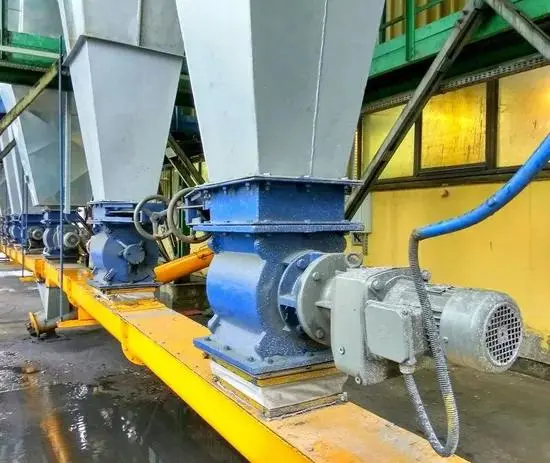
Rotary valves are one of the most commonly used components in powder pneumatic conveying systems.
They operate by rotating an internal rotor to continuously transfer materials from the upper equipment to downstream equipment while providing a certain degree of air sealing.
Due to their advantages including continuous feeding, compact structure, and stable operation, rotary valves are widely used in:
Cement production systems;
Food processing industries;
Pharmaceutical material handling;
Plastic pellet conveying;
Chemical powder conveying systems.
Slide Gate Valve
Slide gate valves mainly control material discharge through linear movement of the gate.
Because of their simple structure, large flow capacity, convenient installation, and low flow resistance, they are widely used in:
- Silos;
- Hoppers;
- Storage tanks;
Powder discharge systems.
The advantages of slide gate valves include:
Full port design to reduce material retention;
Fast opening and closing operation;
Simple maintenance and low operating costs.
Knife Gate Valve
Knife gate valves use a sharp-edged gate structure to cut through media containing particles, fibers, and impurities.
Compared with conventional gate valves, knife gate valves are more suitable for challenging applications such as:
- Mining slurry systems;
- Mud and sludge handling;
- Wastewater treatment;
- Solid particle-containing pipelines.
Y-Type Diverter Valve
In solid material conveying systems, changing material direction is often required according to production needs.
Y-type diverter valves use specially designed flow passages. Compared with traditional T-type structures, they provide smoother material flow and reduce dead zones and material accumulation.
Typical applications include:
- Pneumatic conveying systems;
- Multi-point feeding systems;
- Automated powder processing lines.
Ceramic Valve
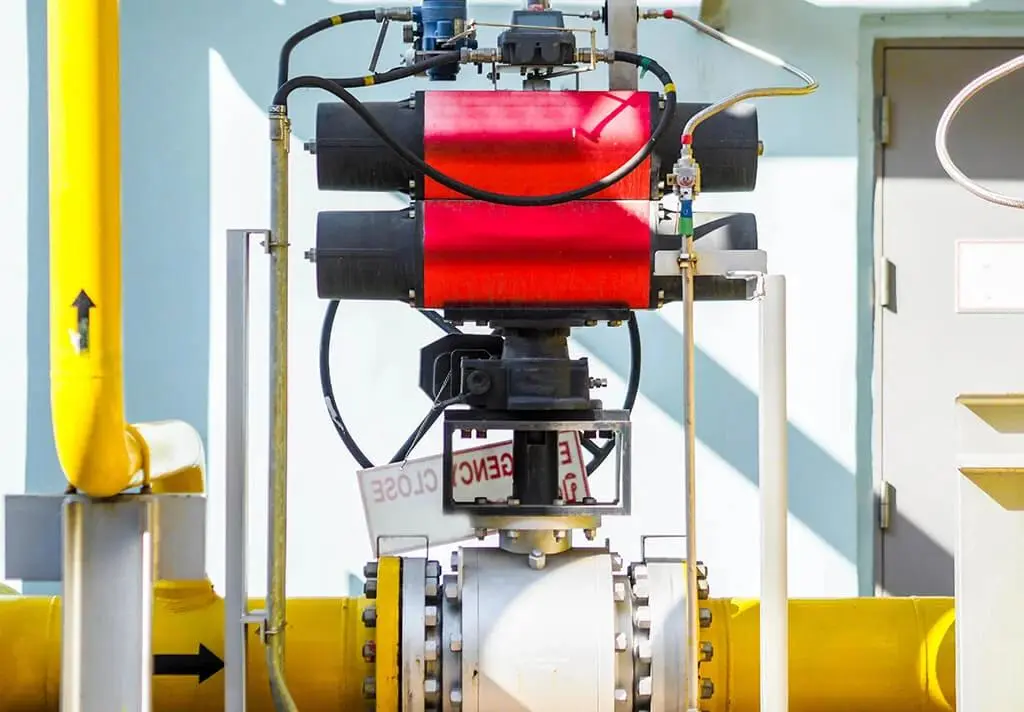
For highly abrasive materials such as mineral powder, power plant ash, catalysts, and quartz sand, conventional metal valves may not provide sufficient service life.
Ceramic valves use materials such as zirconia and silicon carbide in flow passages and sealing areas to improve erosion resistance.
Their advantages include:
- Excellent wear resistance;
- Long service life;
- Suitability for harsh operating conditions.
How to Select Valves for Solid Material Conveying Systems?
Valve selection for solid material conveying should not only consider valve size and pressure rating but also the characteristics of the material and operating conditions.
The particle size and shape of materials should be evaluated first. Large or irregular particles require valve structures that can prevent jamming.
Material hardness is another important factor. Hard particles accelerate valve wear, so wear-resistant materials or special valve designs should be selected.
Other factors that should be considered include:
- Material corrosion characteristics;
- Operating temperature;
- Operating pressure;
- Presence of explosive dust environments.
Different applications require different valve solutions:
- Rotary valves are commonly used in powder pneumatic conveying systems for continuous feeding and air locking.
- Slide gate valves are generally used at the bottom of silos for material shut-off control.
- Knife gate valves are suitable for slurry and particle-containing media.
- Y-type diverter valves are used when changing conveying directions is required.
- Ceramic valves are preferred for highly abrasive materials.
Importance of Sealing Materials and Structural Design
For long-term reliable operation of solid material valves, sealing performance is one of the most important factors. Different operating conditions require different sealing materials. For ordinary powder conveying applications, NBR sealing materials can be used.
Food and pharmaceutical industries usually require silicone rubber or polyurethane materials. Corrosive environments may require FKM sealing materials. High-temperature applications may require PTFE or metal sealing structures.
For materials that easily accumulate or stick inside valves, purge port designs can be added. Compressed air is used to clean residual materials inside the valve chamber and improve operational reliability.
Conclusion: Proper Valve Selection Ensures Stable Solid Material Conveying
Valve selection for solid material conveying systems requires comprehensive consideration of material characteristics, conveying methods, and operating environments.
Compared with conventional fluid valves, solid material conveying valves focus more on:
- Wear resistance;
- Anti-blocking capability;
- Reliable sealing performance;
- Self-cleaning structure.
By selecting suitable rotary valves, slide gate valves, knife gate valves, Y-type diverter valves, and ceramic valves, industries can improve production efficiency, reduce maintenance costs, and achieve long-term, safe, and stable operation of solid material conveying systems.
FAQ
Q1: What valves are commonly used in powder conveying systems?
Common valves used in powder conveying systems include rotary valves, slide gate valves, and Y-type diverter valves. Rotary valves are mainly used for continuous feeding and air locking, slide gate valves are used for material shut-off, and diverter valves are used for changing conveying directions.
Q2: Which valves are suitable for highly abrasive solid materials?
For highly abrasive materials such as mineral powder, ash, and catalysts, ceramic valves or wear-resistant alloy valves are recommended to improve service life and reliability.
Q3: Can butterfly valves be used for powder conveying systems?
Standard butterfly valves are generally not recommended for high-performance powder conveying systems because the disc structure can obstruct material flow, and sealing surfaces may suffer from particle erosion, resulting in leakage and operational problems.

Get professional pre-sales technical consultation and valve selection services, customized solution services.
About CEPAI
Popular Blogs