Pneumatic Bellows Control Valve vs Standard Control Valve
For a process that handles hazardous, flammable, or high-purity media, the sealing mechanism within a control valve is no longer a minor requirement but the decisive element in whether the system is even safe to function. And here is where the contrast between a Pneumatic Bellows Control Valve and a normal control valve comes in. Standard control valves normally use packing around the stem to prevent leakage, but a Pneumatic Bellows Control Valve substitutes that packing with a hermetically sealed bellows, eliminating stem leakage routes altogether. Here at CEPAI Group, we build both types of valves for customers in the petrochemical, chemical, and power generation industries, and this article breaks down exactly how the two compare across sealing, control precision, materials, application fit, and long-term cost, so you can decide which one actually belongs in your process.
What Is a Pneumatic Bellows Control Valve and How Does It Compare to a Standard Control Valve?
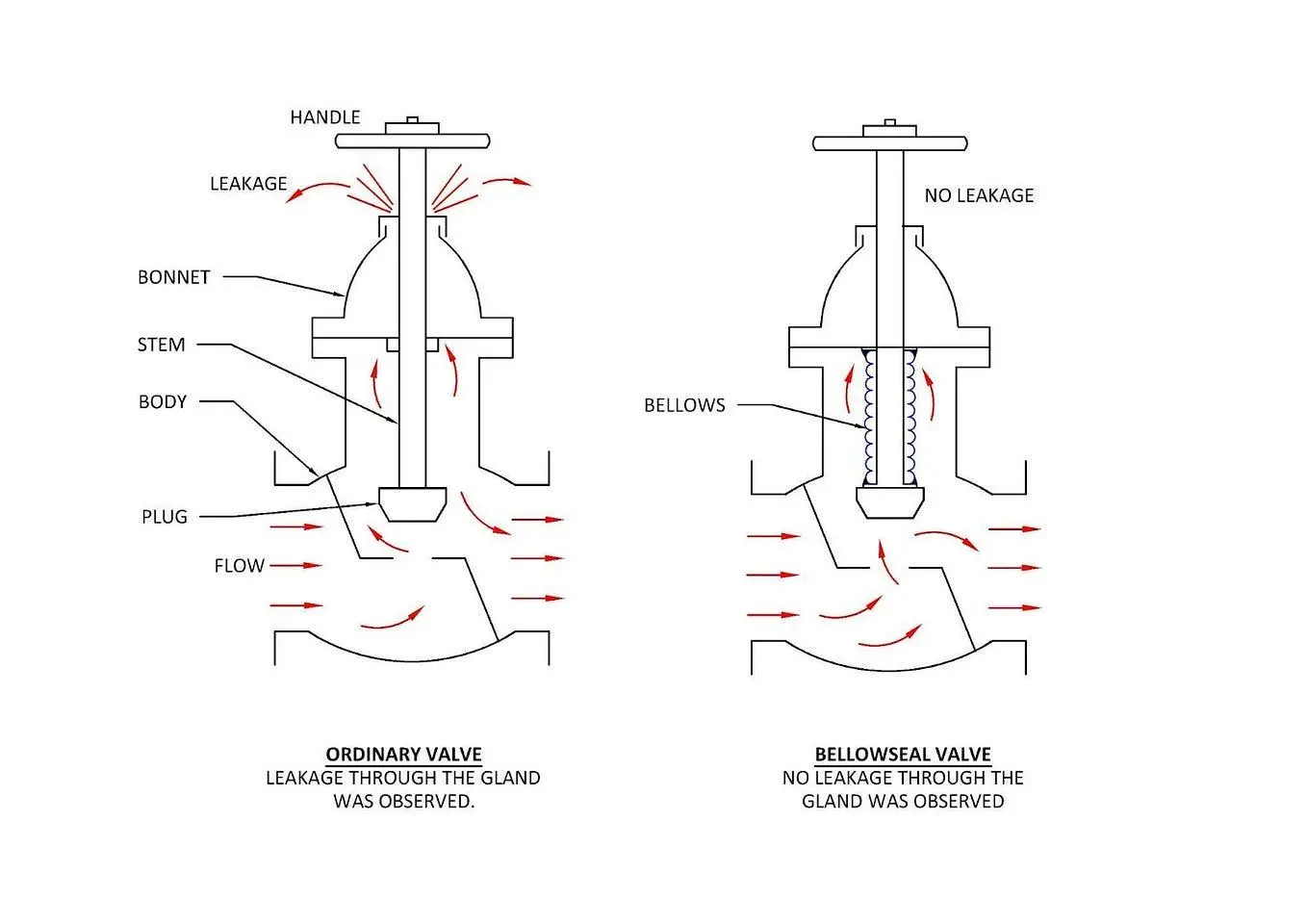
To compare the performance and applicability meaningfully, it is first necessary to understand the basic design difference between these two kinds of valves.
Bellows Sealing vs Traditional Stem Packing
In a typical control valve, a compressed packing material is used to seal the moving stem. This packing material gradually degrades over time and may enable tiny volumes of process fluid to escape down the stem. The Pneumatic Bellows Control Valve adopts a different method with a flexible, accordion-like bellows assembly (usually fabricated in high-grade stainless steel or other specific alloys) that separates the process media entirely from the outside environment. This hermetic design eliminates the need for packing tightness or frequent adjustment to maintain a leak-free seal. This is a substantial structural benefit over packing-based conventional control valves in any application containing hazardous or high-value media.
Pneumatic Actuation and Pressure-Balanced Regulation
Both kinds of valves may be pneumatically actuated, but a Pneumatic Bellows Control Valve offers flow control in a very different manner than a normal design. As the stem is moved by the pneumatic actuator, the bellows element expands or contracts, transmitting stem motion to the valve plug and helping to balance pressure throughout the valve internals. The pressure balancing behaviour reduces the effect of changing line pressure on the accuracy of valve positioning, which a standard control valve without bellows sealing does not inherently provide because its packing arrangement does not offer a comparable pressure balancing function as the actuator moves.
Core Components and Working Principle
The bellows element, valve stem, valve plug, pneumatic actuator, and bonnet are the main components of a Pneumatic Bellows Control Valve. The bonnet covers the bellows and serves as a secondary barrier for sealing. A typical control valve has many of these same components but uses packing material instead of a bellows, which makes it simpler but generally less leak-resistant. This understanding of this component-level difference helps clarify why a Pneumatic Bellows Control Valve, although more expensive upfront, yields fundamentally different performance characteristics than its regular equivalent across sealing, accuracy, and service life.
| Component | Standard Control Valve | Pneumatic Bellows Control Valve |
|---|---|---|
| Stem sealing | Compressed packing | Hermetically sealed bellows |
| Pressure balancing | Not inherent to design | Built into the bellows function |
| Leak path along the stem | Possible over time | Eliminated by design |
Sealing Performance and Leak Prevention
Sealing integrity is often the most important distinguishing factor between the two kinds of valves, particularly in applications where even a small amount of leakage has safety or environmental consequences.
Hermetic Isolation of Process Media
The bellows assembly of the Pneumatic Bellows Control Valve provides total isolation of the stem from the outside environment. Regardless of the number of working cycles the valve is subjected to, the stem path remains free of the outside environment. The normal control valve uses packing compression for its functioning. Eventually, when the packing deteriorates or the seal loosens with cycling in temperature, tiny leak paths may develop. For toxic, flammable, or corrosive media, this difference is not cosmetic - it is a direct element in whether the installation exceeds safety regulations for hazardous service applications.
Fugitive Emission Control and Regulatory Compliance
Many businesses are now under strict fugitive emission laws, and the Pneumatic Bellows Control Valve is often the valve of choice to help facilities comply with these requirements. The fundamental architecture of a Pneumatic Bellows Control Valve provides for sealed operation and hence automatically decreases stem emissions, not by careful maintenance. A normal control valve may, in theory, satisfy emissions goals if it is used with low-emission packing systems, but these systems must be frequently inspected and periodically tightened. A Pneumatic Bellows Control Valve’s bellows design provides a more permanent, maintenance-free compliance option for businesses under increased environmental scrutiny.
Long-Term Seal Reliability vs Packing Wear
Packing is a consumable part of a traditional control valve, and seal efficiency will decrease with time between required maintenance intervals, particularly in high-cycle or high-temperature applications. This steady degradation pattern is not seen in a Pneumatic Bellows Control Valve, since the seal is by the bellows themselves and not by a compressible packing material. While bellows components have a finite fatigue life in terms of working cycles, this kind of failure is very foreseeable and tested, unlike the creeping, less obvious wear that occurs in packing-sealed, traditional control valves after many years of usage.
Control Precision and Process Performance

Apart from the sealing, the two kinds of valves vary considerably in their accuracy and consistency of flow control in actual operation.
Hysteresis and Repeatability
As the stem moves, traditional packing in a normal control valve causes fluctuation in friction, which causes hysteresis—a lag or discrepancy between the valve position that is ordered and the actual valve position. A Pneumatic Bellows Control Valve overcomes most of this friction-induced hysteresis as the sealed bellows design minimises the fluctuating friction of packing, leading to more predictable valve operation and better control loop performance. This enhanced repeatability is very important for situations where the quality of a product or the stability of a process is sensitive to tiny variations from the setpoint.
Flow Modulation Accuracy and Rangeability
The Pneumatic Bellows Control Valve offers uniform, low-friction stem movement throughout the full range of travel and generally offers more accurate flow modulation and better rangeability than a comparable standard control valve, especially at low flow positions where packing friction in standard designs is relatively greatest. This is where the Pneumatic Bellows Control Valve is particularly useful in operations that need delicate control at low flow rates, such as pharmaceutical dosage or speciality chemical mixing, where the performance of normal control valves may become substantially less exact.
Response Speed to Control Signals
The pneumatic actuator on either valve type generally responds quickly to control signals, but the reduced internal friction in a Pneumatic Bellows Control Valve allows the actuator to reposition the stem more smoothly and predictably than it can against the variable resistance of packing in a standard control valve. This means improved real-world response to dynamic process circumstances, with control loops reaching goal setpoints faster and with less overshoot than a normal control valve with similar actuator specifications.
| Performance Factor | Standard Control Valve | Pneumatic Bellows Control Valve |
|---|---|---|
| Hysteresis | Higher, from packing friction | Lower, minimal friction |
| Low-flow accuracy | Reduced at low positions | Maintained across the range |
| Response consistency | Variable with packing wear | Stable throughout service life |
Material Options, Pressure, and Temperature Ranges
Selecting between these two valve types also requires understanding how their available materials and operating envelopes compare.
Body and Bellows Material Selection
Standard control valves offer a wide range of body materials to match general industrial service, while a Pneumatic Bellows Control Valve requires additional attention to bellows material specifically, since this component must tolerate repeated flexing without cracking. High-grade stainless steel and specialized corrosion-resistant alloys are common choices for the bellows element, while the valve body itself can be specified in materials suited to the process fluid, giving a Pneumatic Bellows Control Valve the flexibility to handle both mechanical cycling demands and chemical compatibility requirements simultaneously.
Pressure Class and Temperature Envelope
A Pneumatic Bellows Control Valve is commonly available in pressure ratings including PN16, PN40, and PN64, as well as ANSI Class 150, 300, and 600, covering everything from low-pressure utility lines to demanding high-pressure process piping. Standard bonnet configurations typically support operating temperatures from around -17°C to +230°C, while extended bonnet designs can accommodate cryogenic or high-temperature service with appropriate engineering review. Standard control valves often cover similarly broad pressure and temperature ranges, but without the bellows-specific engineering considerations that a Pneumatic Bellows Control Valve requires for reliable long-term cycling.
Corrosion Resistance for Harsh Media
For chemical processing environments involving acids, bases, solvents, or other aggressive media, material selection becomes especially critical. A Pneumatic Bellows Control Valve built with duplex stainless steel, Hastelloy, or specialized fluoropolymer coatings can maintain structural integrity and sealing effectiveness across demanding chemical exposure, while a standard control valve relying on packing may struggle to maintain leak-tight performance under the same aggressive conditions, since packing materials generally have narrower chemical compatibility ranges than a properly specified bellows and body material combination.
Where Each Valve Type Delivers the Best Value
Ultimately, deciding whether to go with a Pneumatic Bellows Control Valve or a regular control valve is a matter of matching the design advantages to your needs.
Chemical, Pharmaceutical, and High-Purity Processing
The most evident benefit of a Pneumatic Bellows Control Valve is in applications requiring dangerous chemicals, high-purity processes, or environmentally sensitive activities, where the hermetic sealing provides a direct answer to the contamination and emission dangers that these processes simply cannot afford. The ability to modulate flow precisely, combined with absolute containment, makes the Pneumatic Bellows Control Valve especially useful in the pharmaceutical and semiconductor manufacturing industries where exacting process control tolerances and strict contamination control are critical.
Petrochemical, Oil and Gas Applications
In petrochemical and oil and gas processing applications where corrosive acids, volatile organic compounds, and other hazardous chemicals are commonplace, a Pneumatic Bellows Control Valve offers the containment assurance operators want at crucial service points. In less dangerous areas of these facilities, such as utility or cooling water systems, where the repercussions of a leak are less severe and the cost savings of a standard design make more practical sense for the application, a standard control valve may still be a good fit.
General Industrial Use and Total Cost of Ownership
In general industrial applications not involving hazardous media or extreme purity requirements, a standard control valve may still be the more cost-effective solution, as the extra engineering and material costs of a Pneumatic Bellows Control Valve may not result in a proportional operational advantage. However, in any application where valve failure would result in safety incidents, environmental violations or costly contamination, the higher upfront cost of a Pneumatic Bellows Control Valve is generally compensated by less maintenance, fewer emissions-related compliance issues and a longer effective service life.
Conclusion
Whether you should choose a Pneumatic Bellows Control Valve or a normal control valve depends on how important absolute containment, accurate low-flow control, and long-term seal dependability are to your operation. CEPAI Group produces both valve types on the basis of APIQ1, API6D, ISO9001, and CNAS-accredited quality processes, offering clients in the petrochemical, chemical, and power generation sectors a reliable partner for either solution. Our technical team can assist in matching the proper valve technology to your particular process needs with supplier credentials held by PetroChina, Sinopec, and CNOOC. We can help you locate the best solution for your application.
FAQ
Q1: Why does a Pneumatic Bellows Control Valve cost more than a standard control valve?
Its hermetically sealed bellows and specialized materials add engineering and manufacturing costs, but they eliminate stem leakage entirely.
Q2: Does a Pneumatic Bellows Control Valve require more maintenance than packing-based valves?
Generally less, since the bellows seal doesn't need periodic tightening the way compressed packing does over time.
Q3: What pressure and temperature ranges does CEPAI's Pneumatic Bellows Control Valve cover?
Standard ratings include PN16–64 and ANSI 150–600, with temperatures from -17°C to +230°C in standard configurations.
Q4: Is a standard control valve ever the better choice?
Yes, for non-hazardous, general industrial applications where lower upfront cost outweighs the benefits of bellows sealing.
Q5: Can the bellows material be customized for corrosive media?
Yes, options like duplex stainless steel and Hastelloy are available for demanding chemical processing applications.
Ready to Compare Valve Solutions for Your Process?
Not sure whether a Pneumatic Bellows Control Valve or a standard control valve fits your application best? CEPAI Group's engineering team can review your process conditions, media compatibility, and safety requirements to recommend the right solution. Backed by API and ISO certifications and a CNAS-accredited testing laboratory, we deliver dependable valves for demanding industries worldwide. Contact us at sales@cepai.com today to discuss your project and receive a tailored recommendation from our technical team.

Get professional pre-sales technical consultation and valve selection services, customized solution services.

About CEPAI
Popular Blogs