Butterfly Valve Control Guide: Flow Characteristics, Pressure Loss, Cv Calculation and Valve Sizing
In industrial fluid control systems, butterfly valves are widely used not only as shut-off valves but also as flow control valves.
Due to their advantages:
- Simple structure;
- Lightweight design;
- Low installation cost;
- Suitable for large diameter pipelines;
- Flow characteristics close to equal percentage;
butterfly valves are widely applied in:
- Water treatment;
- Oil and gas;
- Chemical processing;
- Power generation;
- HVAC systems.
However, butterfly valves are not suitable for all throttling conditions.
Especially when operating at small openings, butterfly valves may cause:
- Cavitation;
- Erosion;
- Vibration;
- Excessive noise.
Therefore, understanding butterfly valve control characteristics, flow resistance, and correct sizing methods is essential for ensuring stable system operation.
Why Can Butterfly Valves Be Used for Flow Regulation?
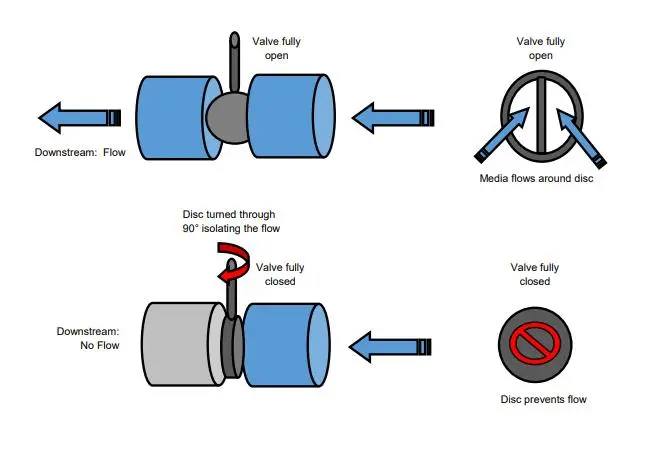
A butterfly valve controls flow by rotating the disc to change the opening area inside the valve.
The rotation angle determines the flow capacity:
- 0°: Fully closed;
- 90°: Fully open.
The flow characteristic of a butterfly valve is close to an:
Equal Percentage Characteristic.
This means:
As the valve opening increases, the flow rate increases gradually at first and then changes more rapidly as the opening approaches full open.
This characteristic is one of the reasons why butterfly valves can be used for flow regulation.
However, butterfly valves have limitations in small opening conditions.
Generally:
- Below 15°–20° opening, continuous throttling is not recommended;
- Between 80°–90° opening, the flow change becomes very small.
Therefore:
The recommended control range of a butterfly valve is usually between 20° and 70°.
Structure of Control Butterfly Valves
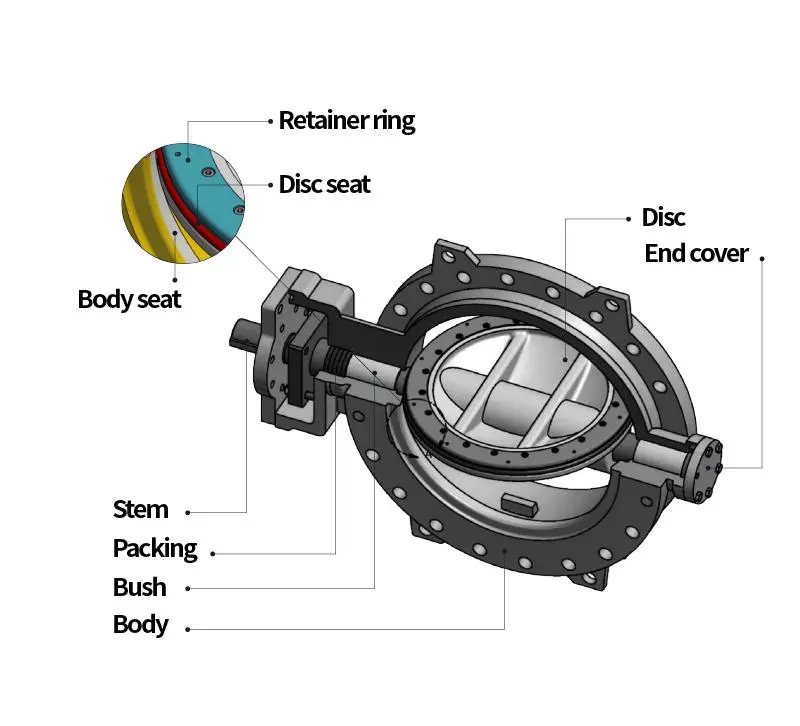
A control butterfly valve is usually equipped with an automatic actuator according to the control requirements.
Common actuator types include:
- Pneumatic actuator;
- Electric actuator;
- Hydraulic actuator.
Among industrial applications, pneumatic butterfly valves are the most widely used.
A typical control butterfly valve consists of:
- Valve body;
- Shaft;
- Disc;
- Seat;
- Actuator.
Butterfly Disc Design
Different disc designs are developed to improve flow performance and reduce operating torque.
(1) Flat Disc Design
Features:
- Simple structure;
- Easy manufacturing;
- Widely used in general applications.
(2) Disc, S-shaped and Fish-tail Designs
To reduce fluid forces and operating torque, some butterfly valves use:
- Disc-shaped designs;
- S-shaped discs;
- Fish-tail discs.
Advantages:
- Reduced flow impact;
- Lower operating torque;
- Improved control performance.
(3) Serrated Disc Butterfly Valve
To improve regulation performance at small openings, serrated disc designs have been developed.
Advantages:
- Improve local flow conditions;
- Reduce vibration;
- Enhance flow control accuracy.
Why Does Cavitation Occur in Butterfly Valves at Small Openings?
Butterfly valves are considered:
High pressure recovery valves.
When the disc is partially open:
- The flow area becomes restricted;
- Fluid velocity increases rapidly;
- Local pressure decreases.
If the pressure drops below the vapor pressure of the liquid:
vapor bubbles are formed.
When these bubbles move into the downstream high-pressure area, they collapse suddenly.
The collapse creates:
- High impact pressure;
- Local stress concentration;
- Material fatigue.
This may result in:
- Disc damage;
- Seat erosion;
- Valve body damage;
- Reduced service life.
Therefore:
Butterfly valves should not operate continuously under small opening throttling conditions.
What Is the Flow Resistance Coefficient of a Butterfly Valve?
When fluid passes through a valve, pressure loss occurs due to:
- Flow direction changes;
- Turbulence;
- Velocity variation;
- Fluid particle collisions.
This pressure loss is represented by the:
Flow Resistance Coefficient (ζ).
The pressure loss can be calculated as:
ΔP = ζ × ρV² / 2
Where:
- ΔP = Pressure loss;
- ζ = Flow resistance coefficient;
- ρ = Fluid density;
- V = Average flow velocity.
Butterfly Valve Flow Resistance Characteristics
When fully open:
- The disc is almost parallel to the flow direction;
- Pressure loss is relatively low.
As the valve closes:
- Flow area decreases;
- Velocity increases;
- Flow resistance increases rapidly.
Therefore:
The flow resistance of a butterfly valve changes significantly with opening angle.
Butterfly Valve Flow Coefficient (Cv/Kv)

The flow capacity of a valve is usually expressed by:
- Cv (Flow Coefficient);
- Kv (Metric Flow Coefficient).
It represents the valve’s ability to pass fluid under a certain pressure difference.
The flow coefficient depends on:
- Valve structure;
- Disc design;
- Opening angle;
- Pressure difference;
- Fluid properties.
A higher Cv value means the valve can handle a larger flow rate.
How to Select Butterfly Valve Size?
Butterfly valve sizing should not simply follow the pipeline size.
The selection should consider:
- Maximum flow rate;
- Normal flow rate;
- Minimum flow rate;
- Operating pressure;
- Temperature;
- Fluid density.
Case 1: Butterfly Valve Used as an On-Off Valve
When a butterfly valve is only used for:
- Fully open operation;
- Fully closed operation;
Selection principle:
The rated flow coefficient of the valve should be greater than the maximum required flow coefficient.
In many cases:
The butterfly valve size is selected equal to the pipeline size.
Example:
Pipeline:
DN500
Valve:
DN500 butterfly valve
Case 2: Butterfly Valve Used as a Control Valve
When the butterfly valve is used for flow regulation:
The required Cv value and operating range must be considered.
Recommended operating range:
Minimum operating condition:
Valve opening:
More than 20°
Maximum operating condition:
Valve opening:
Less than 70°
This helps avoid:
- Poor control performance at small openings;
- Loss of adjustment capability near full opening.
Should a Control Butterfly Valve Use Reduced Size?
In practical applications, control butterfly valves are often reduced in size compared with the pipeline.
Example:
Pipeline:
DN500
Control butterfly valve:
DN400
Advantages:
- Increase effective control range;
- Improve adjustment accuracy;
- Avoid continuous low-opening operation.
However:
The reduction should not be excessive.
Generally:
The butterfly valve diameter should not be smaller than half of the pipeline nominal size.
Important Considerations for Butterfly Valve Control Applications
Avoid Continuous Small Opening Operation
Long-term operation at small openings may cause:
- Cavitation;
- Erosion;
- Noise;
- Vibration.
Select the Correct Disc Design
Different disc designs are suitable for different applications.
Standard butterfly valves:
Suitable for general control.
Special designs:
Suitable for:
- High pressure drop;
- High velocity;
- Severe service applications.
Actuator Selection Must Match the Application
Control butterfly valves usually require:
- Pneumatic actuator;
- Positioner;
- Control signal.
Actuator torque selection should consider:
- Maximum pressure difference;
- Medium pressure;
- Friction force;
- Safety factor.
Conclusion
Butterfly valves are widely used in industrial systems because of their:
- Simple structure;
- Low weight;
- Low cost;
- Suitability for large diameter pipelines.
However:
A butterfly valve is not simply an on-off valve, and it is not suitable for every throttling application.
Proper butterfly valve selection requires consideration of:
- Opening range;
- Flow characteristics;
- Pressure loss;
- Cavitation risk;
- Valve size;
- Operating conditions.
With correct sizing and operating conditions, butterfly valves can provide:
- Reliable flow control;
- Stable operation;
- Easy maintenance.
FAQ
Can butterfly valves be used for flow control?
Yes. Butterfly valves can be used for flow control because their flow characteristics are close to equal percentage.
However, they should generally operate between 20° and 70° opening for stable regulation.
Continuous operation at very small openings is not recommended because it may cause cavitation, vibration, and erosion.
Why are butterfly valves not recommended for small openings?
At small openings, the flow area becomes very restricted.
This causes:
- High flow velocity;
- Large pressure drop;
- Cavitation risk;
- Increased vibration and noise.
Therefore, butterfly valves are usually not suitable for long-term throttling below 15°–20° opening.
How do I select the correct butterfly valve size?
Butterfly valve sizing should be based on:
- Flow rate;
- Pressure difference;
- Temperature;
- Medium properties;
- Required Cv value.
For control applications, the valve should not operate too close to fully closed or fully open positions.

Get professional pre-sales technical consultation and valve selection services, customized solution services.

About CEPAI
Popular Blogs