How Does a cast steel wedge gate valve Work?
If you have ever been through an oil terminal, power station, or chemical factory, you have seen gate valves on the line, but few have paused to question how they truly function. Flow is controlled by a cast steel wedge gate valve that lowers a wedge-shaped gate between two angled seats to form a tight seal, separating one part of the pipe from another. It is not intended for throttling but for on-off duty and is prized for its good sealing, low flow resistance in the open position, and ruggedness. Here’s how a cast steel wedge gate valve works, what its major sections perform, how it operates, where it is used, and how to choose and maintain it.
The Operating Principle of a Cast Steel Wedge Gate Valve
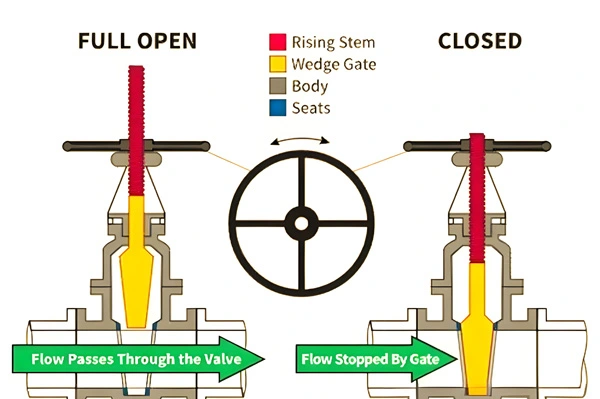
From Fully Open to Fully Closed
A cast steel wedge gate valve has a basic linear action. Turning the handwheel or actuator moves the stem and raises and lowers the gate inside the body. The gate is raised entirely out of the flow channel while in the open position, providing a straight, unimpeded flow passage with very minimal pressure loss. As the gate lowers, it slips in between the seat rings until the wedge form clamps firmly on them. Slow and controlled motion is used to eliminate water hammer in liquid lines. The outcome is visible and tangible: reliable isolation. The position of the stem clearly indicates whether the cast steel wedge gate valve is open or closed.
How the Wedge Creates a Tight Seal
It relies on geometry. The sealing operation. The body seats are machined to fit the two sides of the gate, which are at a small inclination to each other. As the cast steel wedge gate valve is closing, the wedge is wedged between the seats. The downward push from the stem is converted into lateral pressure on both seating surfaces. This force is increased by the line pressure on the upstream side, forcing the gate against the downstream seat, and enhancing the seal. For this reason, a cast steel wedge gate valve can maintain tight shut-off at high differential pressure. The wedge shape also takes care of modest levels of wear, since the gate only sits a bit deeper.
Rising Stem and Non-Rising Stem Operation
Design of the stem impacts installation and operation of the valve. The cast steel wedge gate valve type of rising stem is one in which the stem rises and falls with the gate, thereby providing an obvious position indication and preventing the threads from being in the flow medium. This kind requires a headspace above the valve. A non-rising stem design maintains the stem at a constant height with the gate traveling on its threads within the body, making it suitable for restricted situations such as subterranean or low-clearance sites. Both types perform the same fundamental function. Engineers decide which one to use depending on space, medium, and maintenance.
The table below summarizes the operating sequence.
| Valve Position | Gate Location | Effect on Flow |
|---|---|---|
| Fully open | Lifted clear of the bore | Straight passage, low pressure loss |
| Partly open | Between open and closed | Not recommended for regulation |
| Closing | Wedge sliding toward seats | Gradual flow reduction |
| Fully closed | Wedge locked between seats | Tight isolation |
Key Components and What They Do
Body and Bonnet
The body is the principal pressure-containing element of a cast steel wedge gate valve. The gate and its seats and guides are included in a cast body of carbon steel, such as WCB or alloy and stainless grades for specific duty. Strong walls and smooth interior geometries, which are achievable with cast construction, withstand pipeline loads and high pressure. The bonnet covers the top of the body and carries the stem and packing. A pressure seal or welding based on the pressure class it is linked by bolts. The body and bonnet together create a strong shell that protects the internals and contains the process fluid.
Gate, Seats, and Stem
Inside the cast steel wedge gate valve, the gate, the seats, and the stem are doing the main job. The wedge gate may be solid, flexible or split, each having various advantages for alignment and thermal movement. Seat rings are welded or threaded to the body and sometimes faced with strong alloys such as Stellite for wear resistance. The stem is a precision-machined, generally forged stainless steel shaft that carries the force from the handwheel to the gate. The surfaces of these cast steel wedge gate valve parts are smooth, the tolerances are strict, and the sealing is dependable, which guarantees the service life.
Packing, Gaskets, and Operating Devices
The packing and gaskets are designed to prevent leaking along the stem and at the joints of the body. The gland squeezes graphite or PTFE packing to close around the stem, and spiral-wrapped or ring gaskets seal the bonnet joint. The cast steel wedge gate valve on the top is actuated by a handwheel, gear operator, or electric, pneumatic, or hydraulic actuator. Larger valves often incorporate gears or actuators to decrease effort and for remote operation. The well-chosen sealing components and operating mechanisms make the valve safe to use, simple to maintain, and suited for automated plant systems.
Performance Features in Real Service
Pressure and Temperature Capability
The cast steel wedge gate valve is frequently utilized because it can work under harsh conditions. Cast carbon steel is suitable for a wide variety of temperatures and the valve is available in a wide range of pressure classes from Class 150 to Class 2500 on bigger versions. Special grades are available for low temperature or corrosive duty, and some varieties of alloy steel may be used at higher temperatures, e.g., steam lines. In this way, the cast steel wedge gate valve may be selected to the material and pressure class matching the process and being able to offer safe containment and reliable sealing for many years in harsh industrial applications.
Sealing and Leakage Control
The value of a gate valve is the quality of the sealing. Before shipping, the shell and seat tests verify the strength and tightness of a correctly made cast steel wedge gate valve according to standards such as API 598 or API 6D. Tough seats withstand wear from solids, while repetitive riding and superior packing reduce leaks at the stem. Many designs have fire-safe features and low-emission packing choices to meet environmental regulations. Such nuances allow the cast steel wedge gate valve to operate leak-free, safeguarding people, equipment, and product in essential pipelines.
Durability and Maintenance Convenience
Life span is a function of design and care. The cast steel wedge gate valve has a basic construction, few moving parts, and is easy to examine and repair. Packing is typically adjustable or replaceable without removing the valve from the line. Seats and gates may be reconditioned during scheduled shutdowns. Regular lubrication of the stem and occasional leak inspections will assist in maintaining smooth operation. This simple solution can make a cast steel wedge gate valve last for decades, making it a sensible investment for oil, gas, power and process industries.
The table below highlights the main performance features.
| Feature | How It Is Achieved | Benefit |
|---|---|---|
| Strong containment | Cast steel body and bonnet | Safe pressure handling |
| Tight shutoff | Wedge and hard-faced seats | Reliable isolation |
| Low flow resistance | Full-bore open passage | Efficient flow |
| Easy upkeep | Simple structure, replaceable parts | Longer service life |
Typical Applications
Oil, Gas, and Pipeline Systems
The cast steel wedge gate valve is a typical option for isolation duty in oil and gas operations. It is utilized in collection lines, transmission pipelines, refineries, and storage terminals where its full-bore passage and tight shutdown promote efficient flow and safe maintenance separation. CEPAI has supplier qualifications with PetroChina, Sinopec, and CNOOC. Pipeline and wellhead valves from CEPAI are used in challenging oilfield projects. In these applications, the cast steel wedge gate valve is a proven, reliable solution for crude oil, natural gas, and refined product control and isolation.
Power Generation and Steam Service
Valves in power plants need to be able to tolerate heat, pressure, and frequent operation. An alloy steel cast steel wedge gate valve is extensively used in steam, feedwater, and condensate lines, and its hard body and dependable sealing can bear thermal stress. CEPAI’s clients in the electricity industry include China Datang Group, China Huaneng, and China Electricity Construction. In these facilities, the cast steel wedge gate valve offers safe isolation for maintenance and helps to maintain the plant accessible for generation.
Petrochemical, Metallurgy, and Water Treatment
Valves for diverse media and circumstances are needed by process industries. A cast steel wedge gate valve services hydrocarbon streams, cooling water, and utility lines in petrochemical complexes, steel industries, and water treatment facilities. CEPAI’s clients include Wanhua Chemical, Yulong Petrochemical, Baowu Group and Jingbo Holding. The cast steel wedge gate valve with the right materials and trim offers reliable shutdown and a long service life in all of these applications.
Selecting and Maintaining a Cast Steel Wedge Gate Valve
Matching the Valve to the Process
Good selection starts with process data. Engineers need to specify the fluid, pressure class, temperature range, size and end connections, as well as any corrosion or sour service requirements. They also have to select between rising and nonrising stems, manual vs. actuated action, and solid vs. flexible wedge types. Providing the supplier with all the details enables the cast steel wedge gate valve to be matched with the job and prevents expensive revisions later. Careful specification leads to greater performance, simpler maintenance, and fewer surprises at commissioning.
Standards, Testing, and Manufacturer Capability
Quality assurance safeguards your investment. The cast steel wedge gate valve shall be designed and tested in accordance with recognized standards, such as API 600, API 6D or ISO 10434, etc. CEPAI Group Co., LTD. was established in 2009 in Jinhu, Jiangsu Province, with API Q1, API 6A, API 6D, API 16C, API 602, ISO 9001, ISO 14001, ISO 45001, ISO 3834, ISO 17025, CE and PR2 certificates, a CNAS nationally recognized laboratory and a 56,000 square meter plant. These credentials provide purchasers assurance that each valve is manufactured and tested inside a regulated system.
Installation and Routine Care
The valve functions effectively with proper installation and frequent upkeep. Pipelines should be clean before installation. Flanges should be aligned. Bolts should be tightened equally, and the valve should be placed with adequate space for stem travel. Operators should completely open and close the cast steel wedge gate valve and not leave it half open. Periodically lubricate the stem and inspect the packing for leaks. Inspections may be scheduled during planned shutdowns to detect wear early. Such easy behaviors make the valve reliable and lengthen its service life.
Conclusion
A cast steel wedge gate valve operates by shifting a wedge-shaped gate between angled seats, providing an unobstructed flow route while open and a secure seal when closed. Its sturdy cast body, hard-faced seats, dependable packing, and simple construction make it appropriate for high-pressure, high-temperature duty in oil, gas, power, petrochemical, and water treatment systems. Proper selection, testing to established standards, and periodic maintenance help it provide decades of service. Buyers get a reliable long-term asset when the valve is from a recognized manufacturer. Assess your isolation requirements now and pick a valve engineered to perform.
FAQ
1. What is a cast steel wedge gate valve used for?
It is used for on-off isolation of flow in pipelines and process systems.
2. Why is the gate wedge-shaped?
The wedge locks between angled seats, creating a tight seal that line pressure helps reinforce.
3. Can it be used to regulate flow?
No, it is designed to be fully open or fully closed to avoid seat erosion.
4. What is the difference between rising and non-rising stems?
A rising stem shows the valve position visibly, while a non-rising stem saves vertical space.
5. Which standards apply to the valve?
API 600, API 6D, API 598, and ISO 10434 are commonly used.
Get Reliable Cast Steel Wedge Gate Valves From CEPAI Now
Dependable isolation starts with a well-made valve and a trusted partner. CEPAI Group Co., LTD. combines certified quality systems, a CNAS-recognized laboratory, and a smart factory to supply valves trusted across oil, gas, petrochemical, and power industries. Whether you are building a new pipeline, upgrading plant isolation, or planning maintenance, our engineers can help you select the right cast steel wedge gate valve for your pressure, size, and material needs. Send us your specifications and receive a clear, professional proposal. Contact us at sales@cepai.com and let us support your next project.

Get professional pre-sales technical consultation and valve selection services, customized solution services.

About CEPAI
Popular Blogs